Posted: July 24, 2009 | Author: Scott James | Filed under: 1. Philosophy | Tags: emergency preparedness, prepper |
 In a very real sense, yes.
Every hour I devote to personal self-sufficiency is an hour I take away from my Fair Trade business, which by its very definition is focused on helping others (usually on the other side of the globe). It is an hour I take away from the students I teach each Fall. It is an hour I take away from visiting with friends. It is an hour I take away from sleeping.
So why do I do this?
Partially because I believe a time is coming (likely in my lifetime, definitely in my children’s lifetime) when life will get very local, very quickly. The time I spend in preparations for myself and my family is a selfish investment. But I believe it to be a wise one that will enable us to help others (neighbors, friends, family) later, when they are in dire need due to lack of preparations.
Becoming self-sufficient myself – and teaching my children how to become so, as well – is one of my primary duties as a parent.
Posted: July 23, 2009 | Author: Scott James | Filed under: 3. Food Security | Tags: emergency preparedness, prepper |
 We’re continuing to see some mainstream attention on the lack of food quality in the US (evidence: Roger Ebert’s un-review of the new movie Food, Inc). Now to get the North American’s attention on the next step towards true sustainability: food security via local micro-farms, micro-ranchs, and our own yards.
Related food security note: We’ve got 12 months food about to go into storage. Not tasteless freeze dried stuff, but our normal, organically grown, regionally-grown foodstuffs sealed in metalized bags with oxygen absorbers, packed inside food-grade 5-gallon buckets. Vermin-proof, easy to store, and will last for years and years depending on the type of food. Check that item off the list. What list? The one in Joel Skousen’s compilation called “10 Packs for Survival“.
Also ordered a sweet new Family Grain Mill from Homestead Products for wheat, etc that works on either electricity or manual power. The money I spent on the bulk food + the mill came out to less than buying three months worth of that same food at our grocery store would have cost.
Posted: July 22, 2009 | Author: Scott James | Filed under: 6. Personal Training | Tags: emergency preparedness, prepper |
 If any of the topics I’m talking about here freak you out, consider a quick visit to the PeakShrink’s blog (as in Post Peak Oil), specifically this post. Clearly an interesting woman using her skill set to keep “prepper” readers sane and thinking clearly.
Why is this post tagged as “personal training”? Because it can be dangerous to spend significant time doing personal training for any type of emergency. Part of that personal training should be stress management.
If you lose your positive outlook, or lose the positive reason why you are doing the training (for me, that’s my family), then you are truly lost. You’ll spiral into a negative mindset and attitude, in which you will not be able to help yourself, your family, your friends, your neighbors, your community, nor your country.
Side note: I just learned the catch word preppers a few nights ago doing research. Do you purchase insurance, set aside income for savings, or wear a bicycle helmet? Then you are a prepper, too.
Posted: July 18, 2009 | Author: Scott James | Filed under: 3. Food Security | Tags: food forest, permaculture |
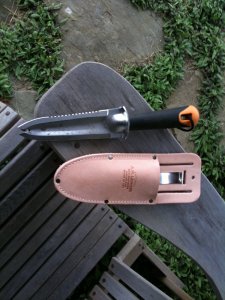
My favorite garden tool is easily my hori hori garden knife that you see pictured here. When I first looked at these I thought they were a bit ridiculous. They look like a giant Rambo survival knife. Useful for those frequent cases of being attacked by rabid deer, but other than that…
It turns out to be that large because the hori hori functions just like a similarly sized hand spade. It also has a handy serrated edge for slashing through small weedy vines and a forked end that pops root weeds up instantly. I love this thing. Mine did not come with a sheath and no local shops had any standalone sheaths the right size, but I found one that fits online.
Be careful you don’t accidentally treat it like a hardened steel Rambo knife, though. I was slicing through some weedy vines on a rock wall with my first hori hori and accidentally smacked the rock pretty hard. The blade snapped right off of the handle.
Other frequently used items include my pitchfork to turn the compost bins weekly and zip ties to quickly secure everything, from bird netting on our cherry trees, to sunflowers falling over themselves with too-big blooms. Note to fellow fans of Square Foot Gardening, when Mel said you can use raised beds that are only 6″ deep, he was probably not thinking you are going to put 10′ sunflowers in those beds. Use a zip tie to attach them to a bamboo stake.
Yes, I know zip ties are a doomed products and a complete ecological waste since they are yet another plastic made of petroleum. When I run out of my current stock, I plan to exclusively use hemp twine.
Posted: July 17, 2009 | Author: Scott James | Filed under: 6. Personal Training |
 I’ve been asked how I have time to work on these emergency preparation projects in the midst of several day jobs + two little kids. Three reasons…
First, I have a very supportive wife. Second, I get insomnia usually once per week, which opens up lots of hours for mind-numbing internet research. And third, I like to delegate.
One of my three day jobs is now mostly run by others I’ve hired, with me only answering the occasional phone call/email asking for advice. My second day job is highly seasonal, keeping me busy only in the Fall. And my third day job – a start-up that occupies 80%+ of my daily work hours – is an experiment in just how much I can outsource and still guide the ship. That experiment may or may not work. 2012 update: the above experiment did in fact work, but that company is now sold to make room in my schedule for a new company I started with three other co-founders who are very bright and very passionate. Will be interesting to see how these concepts that work well for a single founder work in a team environment.
Many different books helped me over the years develop my own style of personal productivity, but there are two standouts. The first book got me to where I was two years ago, which is when I stopped working the normal 8-5 job and started splitting my time among several related jobs. The second book got me to where I am today.
Ten years ago, I was trained by a competitor to David Allen on a system almost identical to his brilliant Getting Things Done. Yes, it is all just common sense, but until you train yourself on a system like GTD (or any of the other similair ones out there), you just won’t act on it consistently, which is crucial. It’s a very effective system.
Two years ago, I read Tim Ferriss’ Four Hour Work Week and was pleased to see two things. One, I was not nuts to try the things I was trying with my day jobs – like outsourcing as much as possible – despite what most of my friends and colleagues were telling me. Two, I had only just begun.
Ferriss pushed the concept way beyond what I would have thought possible. In particular, he opened my eyes to the power of Virtual Assistants. Granted, there are some significant hassles to using VAs, but overall it can make you significantly more productive.
My tools to stay productive and organized have been greatly simplified in recent years. There are now just three of them:
1. iPhone (a small computer that happens to make phone calls; current home page pictured above),
3. My brain, which functions significantly better breathing fresh air, taking 10-minute power naps instead of coffee breaks, and doing micro-yoga sessions while talking on the phone. Not items I had ever been able to access when working at a normal desk job.
Most used apps on the iPhone, in addition to the native ones, are below:
1. ToDo 2Do Things The Hit List Remember the Milk (better task mgmt and sync for iPhone),
2. ReaddleDocs (the missing File Manager / Finder for the iPhone),
3. Evernote (for the text recognition aspect),
4. WinAdmin (to control my servers),
4. QuickVoice Pro (to get thoughts quickly out of my head before they disappear)
5. Dropbox (to keep everything synced, particularly with iPad).
6. WordPress to update the company websites.
7. Asana to keep the teams coordinated and motivated.
8. Basecamp to keep the dev teams cranking (they don’t like Asana).
Posted: July 16, 2009 | Author: Scott James | Filed under: 3. Food Security | Tags: chicken tractor, portable chicken coop |
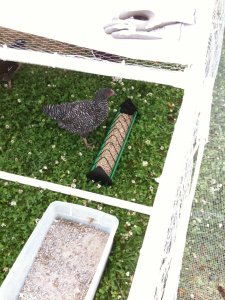
For those of you who asked, we selected our current chicken breeds (Speckled Sussex, Barred Rock, and Dominique) for quietness, egg productivity, cold hardiness, and being OK with confinement. These chickens will spend the entire winter outdoors in the tractor.
I’m not using artificial heat nor lights to increase egg production, so we’ll move from .85 eggs/day/chicken down to .25 eggs/day/chicken in the dark winter months. I know of several other chicken folks in our area who successfully overwinter their chickens outside with no loss of life. The chickens seem to become stronger and do fine.
Other breeds that passed the above four qualifications include: Americana, Plymouth Rock, Australorp, Faverolle, Red Star, Black Star, and Wyanlotte. However, I’ve read some conflicting chicken blogs that state Plymouth Rock and Wyanlotte do *not* like confinement. I suspect we can get around this since they get fresh grass and a new view daily.
We don’t have a rooster because I value quietness (as do my neighbors) and I don’t want fertilized eggs. We have enough local friends with roosters that we can replicate the flock fairly easily.
Posted: July 13, 2009 | Author: Scott James | Filed under: 3. Food Security | Tags: chicken tractor, portable chicken coop |
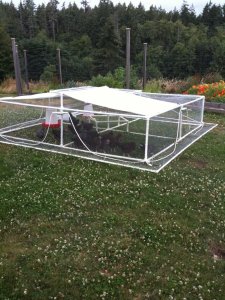
You’ll see I’m pursuing several of my original seven projects in parallel. While I’ve been talking to water sub-contractors re: the cistern, we’ve added chickens to our lives.
For the first time, I don’t feel like I’m wasting my time when I mow my lawn. As Joel Salatin explains, he’s become a grass farmer, which then takes care of all the grazing animals (and other aspects) on his farm.
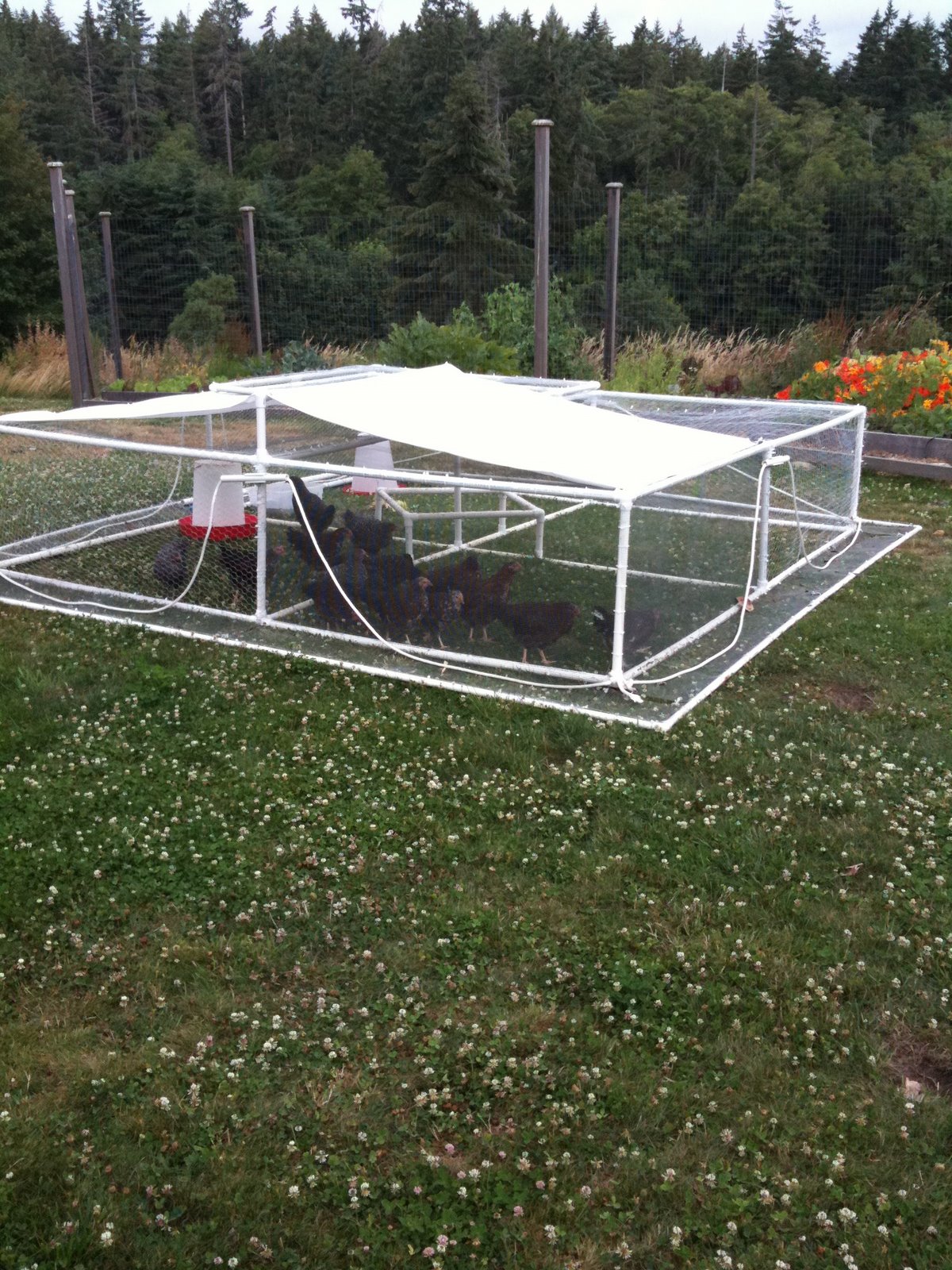
We’ve got 15 egg laying chickens (aka “layers”) in a 10 foot square Salatin-inspired chicken tractor. I found four different styles of tractors locally and on the web, plus some additional research about the digging preferences of coyotes and raccoons, and did a mash-up to create our current tractor design.
The main addition I made to other designs was the hardware cloth skirt to thwart digging predators and the water ski style ropes on each side to easy portability. See additional photos of the tractor and the various components like a portable dust box to the right in the streaming photo collage.
The chicken tractor gets moved to fresh grass daily. It’s light enough that my thin but strong wife can drag it as well. I tried hard to design one made of something renewable like bamboo, but since it rests 100% of the time on the ground, I would have to drench the bamboo with toxic chemicals to ward off mildew and rot.
I ended up using the dreaded PVC, which is terrible for our environment and health when created and when it leaches into our food and water. Because we do not get extensive, intense sun, this PVC will remain stable for years. But I still hate using the damn stuff.
This tractor is clearly version 1.0. I’ve already got a list going of things I would change for the next one, including the addition of a second trap door. When we add three 5-gallon buckets for them to lay eggs in, that one area under the only trap door is going to get crowded. And we’ll see how this tarp design survives a few snowfalls this winter.
Why a chicken tractor rather than a coop?
- Fresh grass daily means healthy happy chickens = healthy eggs = healthy family.
- Moving the coop daily means no buildup of droppings, thus no smell nor diseases.
- My lawn is finally useful. 🙂
Posted: July 11, 2009 | Author: Scott James | Filed under: 2. Water Security | Tags: emergency preparedness, prepper, rainwater harvest |
 Major update July 27, 2009
You might have read about California’s “water war” gearing back up. California has had water issues historically since the West Coast first started to get seriously developed, but many voices are now pointing to water as the next precious natural resource over which *real* wars will be fought.
Related, water rights have also been an ongoing concern for those requiring significant amounts for irrigation or ranches.
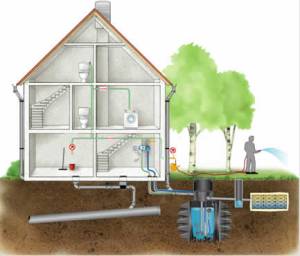
One solution that skirts the legality issues (sometimes) of water rights is roofwater harvesting. My plan is to stem the rain flow from our gutters to a new pond we’ll dig below our current vegetable garden and “food forest” (more on that later in a permaculture post).
Using a solar pump, we’ll bring the water up from the pond to a simple sand filter, then to an underground cistern. Our existing diffuser we already have buried in the backyard will become moot. Bummer. Wish my awareness of water issues had been higher five years ago when we installed the diffuser.
We’ll add a manual diverter between the pond and the sand filter to help keep the cistern water clean in case of a natural emergency (e.g. volcano erupts and we don’t want the ash clogging the filter).
Why an underground cistern? I don’t want anything exterior to the house that screams “We have extra water!”. Because the pond is so far away from the house, it should not attract that much attention. And even then, most folks will think of it as just a pond, not a large holding tank for usable water.
After collecting roof rainwater and having our county folks test it for total coliform counts, copper counts, etc, I know how extensive of a sand filter I need to build. I’ve now got sub-contractors putting together bids now for a 5000 gallon cistern system; our monthly water usage between the house and the gardens is ~ 4800.
So we’ll have one month’s water supply running at normal speed; much longer if we pay attention and ration this precious resource wisely. My goal is to have this complete within the next month or so. We’ll use the cistern water regularly for our garden irrigation, offsetting our water bill and allowing for fresh water to be reclaimed at each new rain.
Can this water be made potable? You bet. A nifty little product called Aerobic K-07 does the trick through hyper-oxygenation. Google it; lots of backpacking/camping gear retailers and websites sell it.
Here’s the rule of thumb to guesstimate how much water you could harvest annually: CATCHMENT AREA (in square feet) multiplied by the AVERAGE ANNUAL RAINFALL (in feet) multiplied by 7.48 (to convert cubic feet to gallons) equals the TOTAL RAINWATER FALLING ON THAT CATCHMENT IN AN AVERAGE YEAR.
So that is CATCHMENT AREA (ft2) x RAINFALL (ft) x 7.48 gal/ft3 = TOTAL AVAILABLE RAINWATER (gal/year). For me, that translates into 695,640 gallons annually.
Interested in learning more about harvesting your own roof runoff? This PDF is viewed as the Bible of rainwater harvesting. Don’t let the “Texas Manual” title throw you off. It is definitely applicable to all areas of the US.
Related side note: using the rule of thumb keeping one gallon of water per person, per day, on hand for emergencies, we’ve also got one month’s water supply stored in jugs. Be sure you don’t store your water jugs on a concrete floor; a chemical reaction occurs over time which fouls the water.
Posted: July 8, 2009 | Author: Scott James | Filed under: 3. Food Security | Tags: food forest, permaculture |
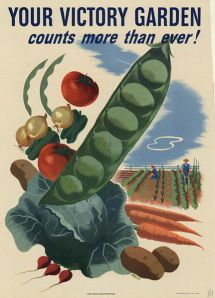 Victory Gardens were the rage during the last two World Wars. 2009 is seeing a resurgence of them for various reasons. [for those who asked, here’s a collection of more hip VG posters]
Why do I specifically garden vegetables and fruit, as well as raise backyard chickens for eggs/meat? For these specific aspects:
- almost zero carbon footprint,
- beyond organic nutritional value,
- life lessons it teaches my children,
- bonding it provides as a shared hobby with my wife,
- barter with other neighbors doing different crops/projects (e.g. honey, soaps, skim balms)
- and the food security it provides, should our local grocery store begin to experience food shortages or rapidly increasing prices due to fuel surcharges. In the mean time we simply save money and eat better.
Our upper gardens are all raised beds for vegetables. Lower gardens have raised vegetable beds cut into the hillside as well as a baker’s dozen of three year old fruit trees.
Posted: July 4, 2009 | Author: Scott James | Filed under: 6. Personal Training | Tags: emergency preparedness, prepper |
 …is to prepare yourself, your family, your neighborhood, and your community to survive and thrive in a new US lifestyle where life gets very local, very quickly.
A practical – but relatively unknown – program most counties in the US offer is called Map Your Neighborhood (here’s an example from Ashland, Oregon). Google this program for your own town and help get your neighborhood prepared for emergencies.
The MYN program walks you and your immediate neighbors through how to prepare for and prevent emergencies in case of a natural disaster, terrorist strike, etc. From simple tasks, like turning off propane gas tanks to prevent explosions, to more complex plans, like what to do with children in the neighborhood who’s parents are injured/dead, this is a well thought out program. Our county sends out a DVD and paper guides, both of which are absurdly useful.
The DVD is full of lots of basic common sense tasks that I simply never thought of (I’m guessing most North Americans have not thought of these things either). Here’s one example; most injuries from earthquakes are from broken glass. Stepping in it, handling it, pushing through it. So these are a few of the items you should keep beside your bed, should the earthquake hit while you are sleeping:
- Pair of shoes.
- Pair of thick gloves.
- Hard hat.
My plan is to do this with our neighborhood, but then take it a step further, preparing our immediate area for disasters that might last longer than the 1-3 weeks the MYN program describes. I can’t think of a more patriotic thing to do than to ensure the health and safety of your neighbors.
Hope your Fourth of July celebration is restful and rejuvenating.
 In a very real sense, yes.
 If any of the topics I’m talking about here freak you out, consider a quick visit to the PeakShrink’s blog (as in Post Peak Oil), specifically this post. Clearly an interesting woman using her skill set to keep “prepper” readers sane and thinking clearly.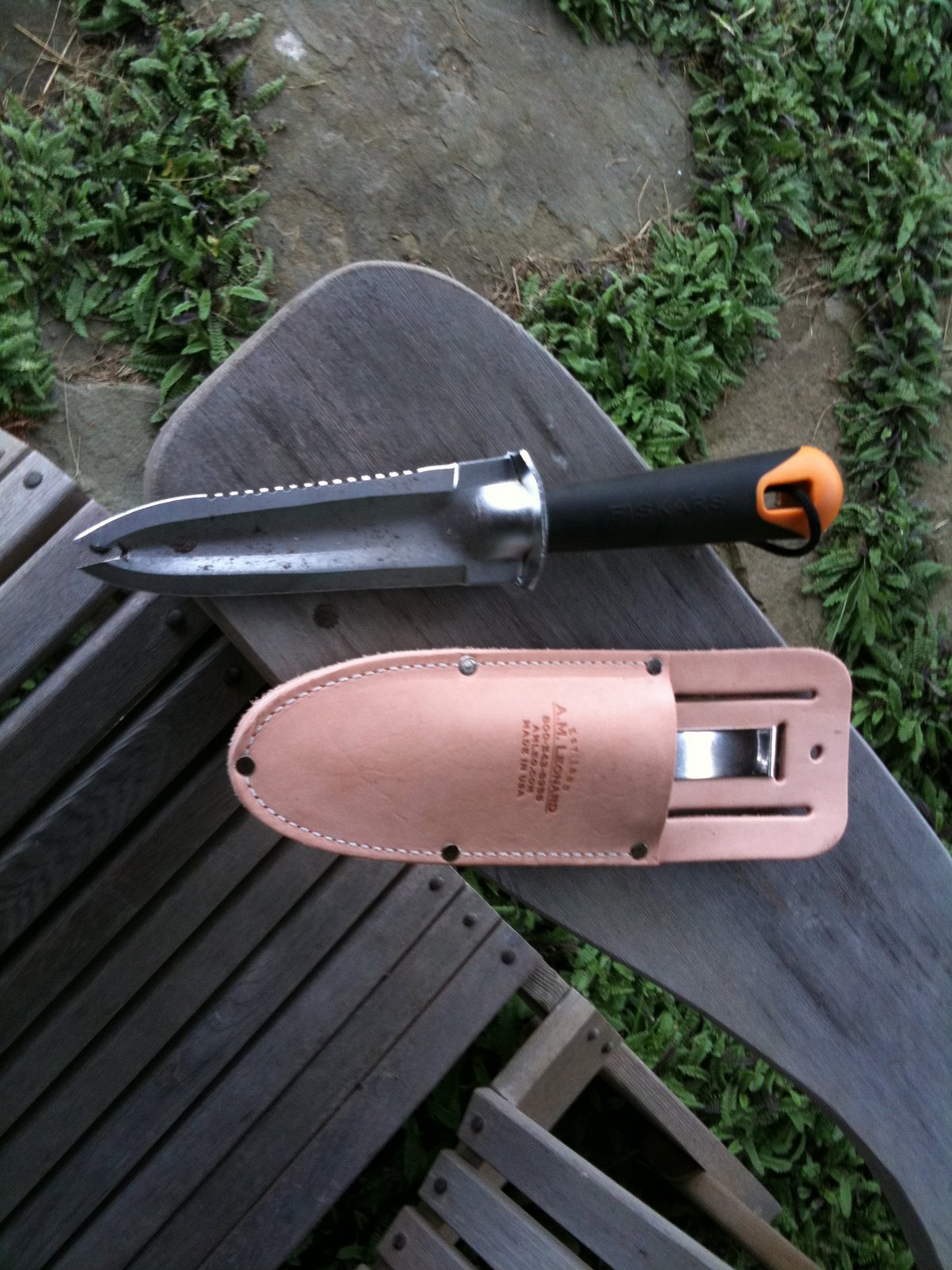
 I’ve been asked how I have time to work on these emergency preparation projects in the midst of several day jobs + two little kids. Three reasons…
 Major update July 27, 2009
 Victory Gardens were the rage during the last two World Wars. 2009 is seeing a resurgence of them for various reasons. [for those who asked, here’s a collection of more hip VG posters]
 …is to prepare yourself, your family, your neighborhood, and your community to survive and thrive in a new US lifestyle where life gets very local, very quickly.
 Opt Out En Masse