Posted: August 6, 2009 | Author: Scott James | Filed under: 1. Philosophy, 2. Water Security | Tags: emergency preparedness, prepper |
 “Awareness arrives in stages.” A fellow named James Kunstler said that. Wise words.
In my own life, awareness of sustainability issues came in waves. First it was organic food, then Fair Trade products, then green cleaning/building products for the home.
Then the combination of studying Peak Oil, global warming, and the recent US economic financial services meltdown led me to where I am today. Although attempting to foresee the future is tricky at best, preparing for future scenarios is prudent. While I am optimistic about future possibilities (e.g. near limitless energy from geothermal, wind, and solar), I am realistic in planning for more negative eventualities (e.g. a pandemic flu correcting our over-populated areas).
But where to begin? Every once in awhile I feel overwhelmed by the negativeness of it all, or the absurd, massive, endless lists of things that I *could* be preparing for. Then I look at my relatively short prioritized task list, take a deep breath, and move towards getting the next item checked off.
If any of you are thinking that way, here’s your *one* task to do this week: buy a bunch of bottled water (2 gallons per person per day for 30 days) and stick it in a closet (but not on concrete; a chemical reaction fouls the water over time). It seems like alot of water when you are buying it and getting weird looks, but not so much once it is stashed in the closet.
Then smile, relax, and tell yourself you are a great person because you’ve got one month of water stored for your family in case of massive tornados, fires, floods, earthquakes, excessive house guests, whatever.
Now that you have your immediate water needs taken care of, you can start reading through the blog posts on food security.
Posted: August 5, 2009 | Author: Scott James | Filed under: 1. Philosophy | Tags: emergency preparedness, prepper |
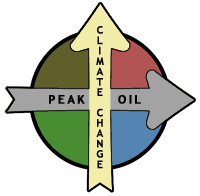
But why a blog on this topic? Well, in the wise words of Green Day’s Billie Joe Armstrong, “silence is the enemy“. We need to be discussing and sharing best practices for moving ourselves as North American citizens (note I did not say “consumers”) towards sustainability.
One group doing an outstanding group of presenting calm, fact-based discussion on these topics is Future Scenarios. It’s a website/book created by David Holmgren, the co-originator of the permaculture concept. Worthwhile.
Posted: July 28, 2009 | Author: Scott James | Filed under: 6. Personal Training | Tags: emergency preparedness, prepper |

While some believe emergency preparedness is best done as a solo effort, far away from “civilization” and prying eyes in a remote location, I believe the opposite to be true. Similair to the conclusion that Neil Strauss reached in his Emergency book, I plan to stay and help when the national emergency hits, not run away from it.
More wisdom from Joel Skousen:
“Possessing a few personal friends you can intrinsically trust at all times is one of the most important contingency preperations you can make.”
Part of my personal training is using some of my natural skill set of marketing and networking (Hey! My current skills are not *completely* useless!) to build a strong network of friends and colleagues who share this same passion for being prepared…and specifically being prepared so that we can help others who did not make preparations to weather the next two week power outage due to us selling our electricity to California, the next local volcanic eruption, or the next national/international economic meltdown. It will take a group of folks who are already prepared and thinking clearly to help our country and cities regain positive momentum.
I’m building three overlapping networks of contacts: local, regional, and national.
The national guys are already in place. It was numerous emails with these lifelong friends (“brothers” would be a more accurate term) that led me to create this blog as a time-saving and information-dispersing vehicle. They are each on their own path – somewhere along this continuum of preparations – from bare minimum (storing two weeks of water and a lot of ammo) to significant (way to go St. Louis!). The general idea is that because we are spread all over the US, if a regional emergency dictates that we need to leave quickly for a short duration (Mt Rainier erupts, chemical spill, whatever) we can go to whichever area is safest. On the to-do list: get Canadian passports in case we have no easy way to reach these friends on the other side of the country during an emergency situation. We can always go north.
The regional network is my least developed at this stage. I suspect it will consist mostly of regional farmers and others concerned with food/water security, but I have not spent alot of thought here yet. If there is a future business idea somewhere in all this thinking/planning/doing, it is likely at the regional level. Something that could be freely shared and replicated in other regions of our country and beyond.
The local network is my current focus. I want to get to know folks that I could reach by walking or bicycling, which limits this network to our small town of 23,000 people who live in a (roughly) 4 mile by 8 mile stretch of land. In a world of very expensive gas, I may still be able to afford to drive a vehicle around, but most folks won’t. Which will lead to something we’ll want to avoid: attention and resentment.
Current local plan:
- Connect the various parts of our small town via ham radio to maintain contact even during emergencies when our phone and cell systems have shown they can be easily overwhelmed. Specifically have these ham radios sit at locations where we are connecting food, water, and reliable heavy transportation (horses). These radios are not sitting at city government offices, but in private homes of clued-in people.
- Map walking/biking/horse riding paths for non-vehicle transportation around our town.
- Create my own personal “Board of Mentors” of those who can train me, help me, and join me in leading our small town in preparedness.
Current local network:
- A close friend who is clued-in and knows many of our local farmers on a first name basis. He’s a rebel rouser who has proven that he can create positive solutions that fly in the face of traditional wisdom. The one who clued me in to Wendell Barry.
- An acquaintance who is an expert on ham radio, electric vehicles as alternative transportation, and has significant financial resources.
- A close friend who has recently become a local micro-farmer / micro-rancher. The one who turned me on to Joel Salatin.
- Several acquaintances who are skilled craftsmen (wood working, plumbing, etc).
- An acquaintance who is a permaculture expert.
- A former student who is an alternative energy expert (solar and wind). We’re setting up a tool next week to measure our wind capabilities for the next year.
- An acquaintance who is an Emergency Medical Technician (EMT) and member of our town’s volunteer fire department. He also trains doing MMA, so he may become a reliable Krav Maga sparring partner as well. Although I’d have to convince him this is not a sport for me, but a way to keep my family and friends safe.
What roles am I missing? You tell me. Either comment below or send me email at optoutenmasse at gmail dot com.
Posted: July 24, 2009 | Author: Scott James | Filed under: 1. Philosophy | Tags: emergency preparedness, prepper |
 In a very real sense, yes.
Every hour I devote to personal self-sufficiency is an hour I take away from my Fair Trade business, which by its very definition is focused on helping others (usually on the other side of the globe). It is an hour I take away from the students I teach each Fall. It is an hour I take away from visiting with friends. It is an hour I take away from sleeping.
So why do I do this?
Partially because I believe a time is coming (likely in my lifetime, definitely in my children’s lifetime) when life will get very local, very quickly. The time I spend in preparations for myself and my family is a selfish investment. But I believe it to be a wise one that will enable us to help others (neighbors, friends, family) later, when they are in dire need due to lack of preparations.
Becoming self-sufficient myself – and teaching my children how to become so, as well – is one of my primary duties as a parent.
Posted: July 23, 2009 | Author: Scott James | Filed under: 3. Food Security | Tags: emergency preparedness, prepper |
 We’re continuing to see some mainstream attention on the lack of food quality in the US (evidence: Roger Ebert’s un-review of the new movie Food, Inc). Now to get the North American’s attention on the next step towards true sustainability: food security via local micro-farms, micro-ranchs, and our own yards.
Related food security note: We’ve got 12 months food about to go into storage. Not tasteless freeze dried stuff, but our normal, organically grown, regionally-grown foodstuffs sealed in metalized bags with oxygen absorbers, packed inside food-grade 5-gallon buckets. Vermin-proof, easy to store, and will last for years and years depending on the type of food. Check that item off the list. What list? The one in Joel Skousen’s compilation called “10 Packs for Survival“.
Also ordered a sweet new Family Grain Mill from Homestead Products for wheat, etc that works on either electricity or manual power. The money I spent on the bulk food + the mill came out to less than buying three months worth of that same food at our grocery store would have cost.
Posted: July 22, 2009 | Author: Scott James | Filed under: 6. Personal Training | Tags: emergency preparedness, prepper |
 If any of the topics I’m talking about here freak you out, consider a quick visit to the PeakShrink’s blog (as in Post Peak Oil), specifically this post. Clearly an interesting woman using her skill set to keep “prepper” readers sane and thinking clearly.
Why is this post tagged as “personal training”? Because it can be dangerous to spend significant time doing personal training for any type of emergency. Part of that personal training should be stress management.
If you lose your positive outlook, or lose the positive reason why you are doing the training (for me, that’s my family), then you are truly lost. You’ll spiral into a negative mindset and attitude, in which you will not be able to help yourself, your family, your friends, your neighbors, your community, nor your country.
Side note: I just learned the catch word preppers a few nights ago doing research. Do you purchase insurance, set aside income for savings, or wear a bicycle helmet? Then you are a prepper, too.
Posted: July 11, 2009 | Author: Scott James | Filed under: 2. Water Security | Tags: emergency preparedness, prepper, rainwater harvest |
 Major update July 27, 2009
You might have read about California’s “water war” gearing back up. California has had water issues historically since the West Coast first started to get seriously developed, but many voices are now pointing to water as the next precious natural resource over which *real* wars will be fought.
Related, water rights have also been an ongoing concern for those requiring significant amounts for irrigation or ranches.
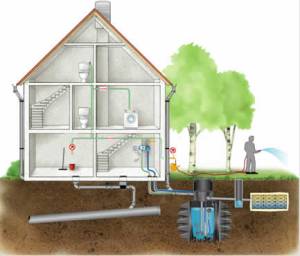
One solution that skirts the legality issues (sometimes) of water rights is roofwater harvesting. My plan is to stem the rain flow from our gutters to a new pond we’ll dig below our current vegetable garden and “food forest” (more on that later in a permaculture post).
Using a solar pump, we’ll bring the water up from the pond to a simple sand filter, then to an underground cistern. Our existing diffuser we already have buried in the backyard will become moot. Bummer. Wish my awareness of water issues had been higher five years ago when we installed the diffuser.
We’ll add a manual diverter between the pond and the sand filter to help keep the cistern water clean in case of a natural emergency (e.g. volcano erupts and we don’t want the ash clogging the filter).
Why an underground cistern? I don’t want anything exterior to the house that screams “We have extra water!”. Because the pond is so far away from the house, it should not attract that much attention. And even then, most folks will think of it as just a pond, not a large holding tank for usable water.
After collecting roof rainwater and having our county folks test it for total coliform counts, copper counts, etc, I know how extensive of a sand filter I need to build. I’ve now got sub-contractors putting together bids now for a 5000 gallon cistern system; our monthly water usage between the house and the gardens is ~ 4800.
So we’ll have one month’s water supply running at normal speed; much longer if we pay attention and ration this precious resource wisely. My goal is to have this complete within the next month or so. We’ll use the cistern water regularly for our garden irrigation, offsetting our water bill and allowing for fresh water to be reclaimed at each new rain.
Can this water be made potable? You bet. A nifty little product called Aerobic K-07 does the trick through hyper-oxygenation. Google it; lots of backpacking/camping gear retailers and websites sell it.
Here’s the rule of thumb to guesstimate how much water you could harvest annually: CATCHMENT AREA (in square feet) multiplied by the AVERAGE ANNUAL RAINFALL (in feet) multiplied by 7.48 (to convert cubic feet to gallons) equals the TOTAL RAINWATER FALLING ON THAT CATCHMENT IN AN AVERAGE YEAR.
So that is CATCHMENT AREA (ft2) x RAINFALL (ft) x 7.48 gal/ft3 = TOTAL AVAILABLE RAINWATER (gal/year). For me, that translates into 695,640 gallons annually.
Interested in learning more about harvesting your own roof runoff? This PDF is viewed as the Bible of rainwater harvesting. Don’t let the “Texas Manual” title throw you off. It is definitely applicable to all areas of the US.
Related side note: using the rule of thumb keeping one gallon of water per person, per day, on hand for emergencies, we’ve also got one month’s water supply stored in jugs. Be sure you don’t store your water jugs on a concrete floor; a chemical reaction occurs over time which fouls the water.
Posted: July 4, 2009 | Author: Scott James | Filed under: 6. Personal Training | Tags: emergency preparedness, prepper |
 …is to prepare yourself, your family, your neighborhood, and your community to survive and thrive in a new US lifestyle where life gets very local, very quickly.
A practical – but relatively unknown – program most counties in the US offer is called Map Your Neighborhood (here’s an example from Ashland, Oregon). Google this program for your own town and help get your neighborhood prepared for emergencies.
The MYN program walks you and your immediate neighbors through how to prepare for and prevent emergencies in case of a natural disaster, terrorist strike, etc. From simple tasks, like turning off propane gas tanks to prevent explosions, to more complex plans, like what to do with children in the neighborhood who’s parents are injured/dead, this is a well thought out program. Our county sends out a DVD and paper guides, both of which are absurdly useful.
The DVD is full of lots of basic common sense tasks that I simply never thought of (I’m guessing most North Americans have not thought of these things either). Here’s one example; most injuries from earthquakes are from broken glass. Stepping in it, handling it, pushing through it. So these are a few of the items you should keep beside your bed, should the earthquake hit while you are sleeping:
- Pair of shoes.
- Pair of thick gloves.
- Hard hat.
My plan is to do this with our neighborhood, but then take it a step further, preparing our immediate area for disasters that might last longer than the 1-3 weeks the MYN program describes. I can’t think of a more patriotic thing to do than to ensure the health and safety of your neighbors.
Hope your Fourth of July celebration is restful and rejuvenating.
Posted: July 3, 2009 | Author: Scott James | Filed under: 1. Philosophy, 6. Personal Training, 7. Physical Security | Tags: emergency preparedness, prepper |

Specifically, I am preparing my family and home for the following scenarios. Some are much more likely to happen than others.
1. Earthquake, volcanic eruption, severe winter storm, environmental meltdown
We live on a (currently inactive) fault line. We live near an overdue volcano. We lose electricity 1/2 dozen times each winter. The longest outage recently was 11 days in late December / early January. It was darn cold. But “environmental meltdown”? Isn’t that a bit dramatic? Watch this recent series from ABC and decide for yourself: Earth 2100: Civilization at Crossroads. Additional videos and more thoughtful commentary are here.
2. Terrorist attack (nuclear, biological, chemical)
Before 9/11 happened I would have given this a 1% chance of happening. But given that my day job revolves around importing Fair Trade products from Pakistan, a known terrorist-harboring country that is not remotely stable, my gut tells me the percentage likelihood of something else bad (bad like on the 9/11 scale of bad) happening during my lifetime is quite high. Especially since I live near a heavily trafficked West Coast port in the US.
3. Economic meltdown
Whether it is the Peak Oil theory (yes, I know there are lots of folks who think this is nonsense) or a US financial system meltdown (hey, that just happened!), this could lead to limited transportation + limited cash + looting. Lots of other folks go into the details of who, how, and why. It’s worth researching for yourself.
4. Home invasion (short-term burglary)
This is more than just a casual concern. While we live in a very safe town and neighborhood, once I had children my protective instincts and radar for this went *way* up. If you walk down the fairly logical path of any of the above scenarios, whoever *is* prepared (e.g. you have water and food for your family and neighbors) is likely going to become a target, particularly from those outside your neighbors and community.
Posted: July 3, 2009 | Author: Scott James | Filed under: 1. Philosophy | Tags: emergency preparedness, prepper |
 I’ve been going down this path for the past three months. Here’s my thought process to date on the frequent question of “Why did you start thinking about this?” that I get from close friends when they ask me about my current project load…
All of this falls into a broad category of what you might call “emergency preparedness”. I actually had a family member involved in an EP company for a decade, so you would think this might have occurred to me earlier, but no.
What is motivating me? Positive, solution-seeking thinking/planning in these areas:
1. My kids
As soon as we began having children, my instincts went way up in terms of protection, provision, and training. I want to raise well-rounded, positive-outlook children that are equipped to help others and change the world for the better. IMO, that takes *alot* of work.
2. The movements of Green + Peak Oil + Go Local + Beyond Organic
Although everything “green” is sexy these days – usually leading to shallow change, unfortunately – there is actually quite a bit of authentic change happening. I’m a big believer in “technology as savior”, although I’m skeptical we can catch up with our environment before a major correction happens (read: worldwide plague, ocean level rising). History tells us these corrections do happen.
However, we are seeing some exciting technologically-based solutions coming to market. Rapid, significant improvements annually in alternative energy such as solar, wind, and geothermal are happening right now. Witness the re-birth of the oil wildcatter T. Boone Pickens as a wind farm proponent and investor.
One of my organizations is heavily involved in these movements, so I get to see a fair number of inside peaks at these positive innovations.
3. Fair Trade movement
I’ve been involved in this “Fair Trade” experiment to correct our unsustainable economic model for the past six years (I’m currently on the winning end of that unsustainable model, thankfully). Witness China + Russia + India all vying for our spot as Last Standing Superpower. Research movements like Fair Trade Towns and Transition Towns that are trying to get our US cities off their oil dependency and unjust (and thus unsustainable) economic systems that we’ve built over the past couple hundred years.
4. My personal health
I am nearing 40 years old. I catch the flu/allergies 2-3X per season despite eating and drinking quite healthily. So I am reminded daily of my desire to get away from toxic, unnatural products and the system that creates them.
5. My personality as a Planner and Networker
I’ve been described as a “geek with people skills”. I enjoy and thrive on meeting other people and networking via high quality conversations. My desire is to see true lasting positive change on a local, regional, national, and international level. Both my day jobs focus on the international aspect. These personal efforts documented here will focus on the local and regional aspects.
In short, I’m a dork for preparedness, I’ve just never applied it to potential emergencies before. What kind of emergencies? Next post…
 “Awareness arrives in stages.” A fellow named James Kunstler said that. Wise words.

 In a very real sense, yes.
 If any of the topics I’m talking about here freak you out, consider a quick visit to the PeakShrink’s blog (as in Post Peak Oil), specifically this post. Clearly an interesting woman using her skill set to keep “prepper” readers sane and thinking clearly.
 Major update July 27, 2009
 …is to prepare yourself, your family, your neighborhood, and your community to survive and thrive in a new US lifestyle where life gets very local, very quickly.
 I’ve been going down this path for the past three months. Here’s my thought process to date on the frequent question of “Why did you start thinking about this?” that I get from close friends when they ask me about my current project load…
 Opt Out En Masse