Building a “food forest”
Posted: October 13, 2009 Filed under: 3. Food Security | Tags: food forest, permaculture Comments Off on Building a “food forest”
We’re creating our version 1.0 food forest. It’s a system of food crops arranged to mimic a natural’s forest ecosystem. Our fruit trees are the top canopy, berry bushes the mid-canopy, with normal vegetables making up the remaining forest layers.
It’s been fun to build, although quite a bit of work and I blew my budget by a factor of 3X. Several times during the construction I wondered if this was my version of a mid-life crisis. It probably is. Oh well, it least a food forest is more productive for my family than a little red sports car.

We started with this sketch of an existing site on our property where I had installed deer fencing and drip irrigation already for 15 fruit trees and a handful of raised beds. I had already chipped rough stairs out of our heavy clay soil. We laid out the pathways between the existing two year old fruit trees with tape. We then brought in 30 yards of compost/dirt to build the new mounded beds.
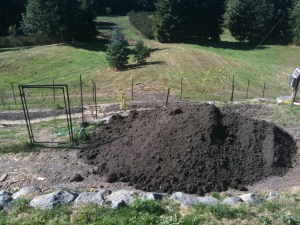
This is the second of two loads. The first 15 yards of compost/dirt only made three beds (you can see them in the background). We could probably use a third load, but I’m *really* tired of hauling dirt up and down this hill. We’ll expand next spring for version 2.0.
Note to self: a truck containing 15 yards of moist compost/dirt is pretty darn heavy. Heavy enough that it will snap any irrigation piping in the ground that it rolls over. Oops. This one only cost me $4 to fix, but several hours of digging to find the broken pipe.
First eggs
Posted: October 12, 2009 Filed under: 3. Food Security | Tags: chicken tractor, portable chicken coop Comments Off on First eggs
Ah, the joys of “maiden eggs” (as Joel Salatin brands these small pullet eggs). We finally get to enjoy the benefits of the chicken tractor investment.
Permaculture expert
Posted: September 30, 2009 Filed under: 3. Food Security | Tags: food forest, permaculture Comments Off on Permaculture expert
I mentioned a “food forest” we’re working in several posts. Here’s a bit of background and an image to explain what that is….
Growing your own
Posted: September 29, 2009 Filed under: 3. Food Security | Tags: food forest, permaculture Comments Off on Growing your own
“Growing food in one of the most dangerous occupations on the face of this earth, because you are in danger of becoming free.”
An experiment in simplicity
Posted: September 27, 2009 Filed under: 1. Philosophy | Tags: emergency preparedness, prepper Comments Off on An experiment in simplicity
Protecting your cash assets from hyperinflation
Posted: September 25, 2009 Filed under: 8. Wealth Management | Tags: emergency preparedness, prepper Comments Off on Protecting your cash assets from hyperinflation For a great summary on how we got into the mess we’re in, check out the NPR podcast “Return to the Giant Pool of Money“. If you don’t use iTunes, do a search for episode #390 of the This American Life show from Chicago Public Radio from just a few weeks ago.
In the podcast, they mark the anniversary of the economic collapse: recapping some of the original episode and finding out what’s happened to the folks featured in the story in the year since.
My main takeaway: the economic collapse was not something They did, but something We did. We (you and I) are the global pool of money. This is not something we can blame on Wall Street, but on basic human greed, seen at a catastrophic global scale.
And while we’re talking about money, you might look into just how secure (or not) your bank account is. Use this tool and go for B+ or higher rated bank.
Testing your bicycle awareness
Posted: September 24, 2009 Filed under: 5. Alt Transportation | Tags: car replacement bicycle, cargo bike, cargonista, electric ute, kona ute Comments Off on Testing your bicycle awarenessA humorous (and effective) reminder to pass along to your non-bicyclist friends. Be sure to remind them that with Peak Oil, they will likely become bicyclists in the not-too-distant future. Whether they want to or not.
A new martial arts teacher and perspective
Posted: September 20, 2009 Filed under: 7. Physical Security | Tags: emergency preparedness, martial arts, MMA, prepper, self defense, self offense Comments Off on A new martial arts teacher and perspective Re-engaged with a new (old) teacher for physical security training recently. I’ve known this fellow for years, trained under him awhile ago, and trust him to teach me these potentially deadly techniques with the correct mindset. Specifically, one of being positive and solution-focused.
- A jo is basically a long stick. Between hiking sticks and garden tools, I spend a fair amount of my day with something like a jo already in my hand.
- A kubotan can be any small cylindrical object. For me, that’s the space pen, small tactical flashlight (during travel) , or pocket multitool (not during travel) that are always in my pockets.
- The fighting sticks are martial arts version of a policeman’s baton. I keep a collapsible ASP baton attached to my bedside so I can sleep better.
And why weapons training at all? Because a recent discussion with my wife made it clear to me that I will never be allowed to store guns in our house, loaded or unloaded. Scratch that, once the local coyotes and raccoons started attacking our chickens, guns made it onto the approved list. But this logic still applies for those (many) times when I am not armed. I can usually find something nearby to serve as a stick.
How to get your spouse involved
Posted: September 17, 2009 Filed under: 1. Philosophy | Tags: emergency preparedness, prepper Comments Off on How to get your spouse involved
- Earthquakes
- War
- Food/Water shortages
- Looting
I expanded each of these with her to include the areas you see here and launched this blog to document our successes and failures preparing for each of these scenarios in order to encourage others to opt out en masse as well.
Physical security training begins
Posted: September 17, 2009 Filed under: 7. Physical Security | Tags: emergency preparedness, martial arts, MMA, prepper, self defense Comments Off on Physical security training begins This part of my Physical Security task overlaps with my Personal Training task. Much of physical security is centered on hardening my home to burglars and would-be home invaders, but a portion of this task is the hardening of myself.
 Opt Out En Masse