Investing for the Peak
Posted: September 14, 2009 Filed under: 8. Wealth Management | Tags: emergency preparedness, prepper Comments Off on Investing for the Peak

- General Electric (NYSE: GE): largest producer of domestic wind turbines and innovative new hybrid locomotives
- Zoltek (NASDAQ: ZOLT): US based maker of carbon fiber, which goes into modern wind turbines (and really cool bicycles)
- Toyota: clearly the leader in hybrid vehicles for consumers, particularly with their upcoming plug-in hybrid (PHEV). Although Peak Oil will likely send all vehicles to the junkyard early, Toyota seems best positioned as a good investment during these transitional years.
- Railroads; Gates, Buffet, and Soros are all buying into Canadian National Railway, Burlington Northern, Union Pacific, Norfolk Southern, and CSX.
Anniversary of 9/11 tragedy
Posted: September 11, 2009 Filed under: 1. Philosophy | Tags: emergency preparedness, prepper Comments Off on Anniversary of 9/11 tragedyOn this solemn day, I’m reminded of a quote from Paul Hawken (of the Smith & Hawken garden supply company, among other things).
“Doom and optimism are twins. One does not exist without the other. The only way you can be truly hopeful about the future is to have a very accurate read on the problems of the present.”

Portable chicken coop additions
Posted: September 10, 2009 Filed under: 3. Food Security | Tags: chicken tractor, portable chicken coop Comments Off on Portable chicken coop additions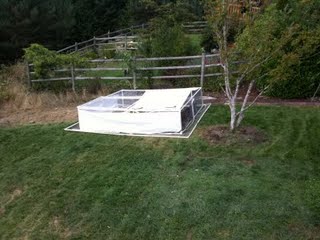 Our first couple of winter-style storms blew through recently. Had a chance to observe the effects on portable chicken coop.
There was no issue with the coop trying to turn into a kite via the tarp and sail off. But I found that if I added another section of tarp on the SW corner (the direction our storms come from), it served two purposes. The new tarp both stops the strong storm wind from chilling the chickens and also provides shade for the longer days of late summer, when the sun can still get quite hot.
In anticipation of our 15 birds beginning to lay eggs for the first time, we also added a few “nest boxes” to the coop as well. These are simply upside down 5 gallon buckets with doors cut into them.

Sand + dichotomous earth on the bottom gives enough weight to keep the buckets upright. The spikes on top keep the chickens from roosting and pooping all over them. I admitted defeat and used store-bought spikes after trying twice to make my own from bamboo sticks.
Injured chicken + chicken tractor = ?
Posted: August 26, 2009 Filed under: 3. Food Security | Tags: chicken tractor, portable chicken coop Comments Off on Injured chicken + chicken tractor = ?One of our Dominiques was getting her butt kicked – literally – by the rest of the chickens a couple of weeks ago. By the time we got to her she had a seriously bloody butt and no feathers left back there.
After separating her and her brood sister off in a temporary pen, I begin pondering solutions. What to do with an injured chicken when you are relying on a portable chicken tractor for the flock, rather than a stationary coop?
I was puzzled for a few days, almost ready to build a second much smaller chicken tractor (and effectively double my daily chicken chores), when I decided to instead try a simple modification to the existing 10′ square tractor.
Here’s a video of the modification (just a line of pipe + wire to separate off an 18″ sliver of the tractor) and the resulting standoff once we reintegrated the birds. Imagine the Gunsmoke theme, or perhaps when the Outsiders lined up against the rival gang. The chickens lined up along the new partition, flapping their wings, pecking at the wire, and giving each other the evil eye. It was hilarious. Well, “hilarious” in a chicken standoff kind of way.
Alternatives to gas-powered cars
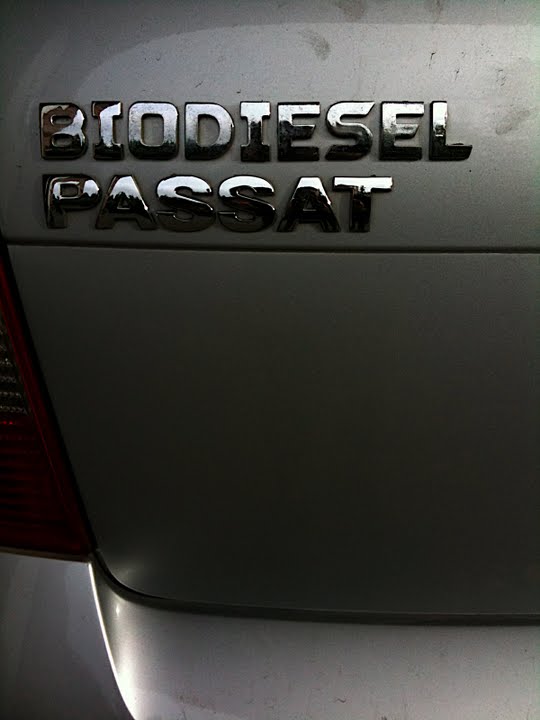
Posted: August 24, 2009 Filed under: 5. Alt Transportation | Tags: car replacement bicycle, cargo bike, cargonista, electric ute, kona ute Comments Off on Alternatives to gas-powered cars We are blessed with two working cars which are completely paid off. One is gas-powered, the other diesel-powered. We run biodiesel through our VW Passat, which is the primary family vehicle. Great gas mileage and can haul quite a bit of gear + kids. And yes, I’m aware that biodiesel is not a long-term solution as an alternative fuel.
But what to do about our other vehicle, a Subaru Outback? It’s a terrific car, but dependent on gas. And it is primarily used by me for work meetings and errands alone. That’s a single person driving around a wagon capable of hauling quite a bit of stuff. And it is unloaded 90% of the time. Not a good use of resources; both ours and the earth’s. Time to fix this.
- Ride on 5% trails, 15% gravel, 80% road (live on a 1/2 mile gravel road).
- Weekly trips to town for meetings and light chores (UPS Store; book, drug, and hardware stores).
- Heavy hauling monthly chores (grocery store; garden supply compost and chicken feed).
- Four miles one way for all trips.
- 100 lbs of chicken feed (two 50 lb. bags).
- Dojo gear (long thin sticks) and soccer gear (e.g. balls, cleats, cones).
- Groceries (4-8 bags).
- Small miscellaneous errand stuff (book, drug, and hardware stores).
- Medium sized packages for work to/from UPS Store.
- Normal bike + electric assist + trailer.
- Electric bike + trailer.
- Cargo bike + electric assist.

I ordered my option #3 cargo bike last week. I should receive my new 2010 Kona Ute (pictured here) sometime in October/November. Why a new bike rather than used? I could not find a way to build up my own longtail cargo bike for less than the $900 Kona Ute price tag, especially with front/rear disc brakes.

Well, no. So why does an in-shape bicyclist need electric assist? To conquer these hills while hauling 100 lb loads, and so that I can arrive at work meetings not too sweaty (no shower facilities).
The two other options my wife and I have discussed for replacing the Outback (but ultimately dismissed) were:
- Replace it with a plug in hybrid (PHEV) like the upcoming Toyota Prius. Assuming we are recharging the battery from green energy (we are), this is a decent medium-term solution for transportation. We could be electric only for 90% of the driving time, given our small town commute. Dismissed for large initial cost and the fact that these will not be out for months (an expensive aftermarket mod is available now).
- Replace it with a motorcycle, which gets significantly better gas mileage. I’ve ridden for years, but given that we now have young children, my wife is less enamored with this option. And the hauling capacity is not terrific, even with a good set of panniers. And it is still oil-dependent. Three strikes and you are out. Dismissed.
Solar and wind power
Posted: August 9, 2009 Filed under: 4. Energy Security | Tags: emergency preparedness, prepper Comments Off on Solar and wind power We added a new feature to our view this week. Look closely in the picture and you’ll see a 30′ high pole with a small wind measurement tool on top.
Awareness arrives in stages
Posted: August 6, 2009 Filed under: 1. Philosophy, 2. Water Security | Tags: emergency preparedness, prepper Comments Off on Awareness arrives in stages “Awareness arrives in stages.” A fellow named James Kunstler said that. Wise words.
Then the combination of studying Peak Oil, global warming, and the recent US economic financial services meltdown led me to where I am today. Although attempting to foresee the future is tricky at best, preparing for future scenarios is prudent. While I am optimistic about future possibilities (e.g. near limitless energy from geothermal, wind, and solar), I am realistic in planning for more negative eventualities (e.g. a pandemic flu correcting our over-populated areas).
But where to begin? Every once in awhile I feel overwhelmed by the negativeness of it all, or the absurd, massive, endless lists of things that I *could* be preparing for. Then I look at my relatively short prioritized task list, take a deep breath, and move towards getting the next item checked off.
If any of you are thinking that way, here’s your *one* task to do this week: buy a bunch of bottled water (2 gallons per person per day for 30 days) and stick it in a closet (but not on concrete; a chemical reaction fouls the water over time). It seems like alot of water when you are buying it and getting weird looks, but not so much once it is stashed in the closet.
Then smile, relax, and tell yourself you are a great person because you’ve got one month of water stored for your family in case of massive tornados, fires, floods, earthquakes, excessive house guests, whatever.
Now that you have your immediate water needs taken care of, you can start reading through the blog posts on food security.
Why a blog?
Posted: August 5, 2009 Filed under: 1. Philosophy | Tags: emergency preparedness, prepper Comments Off on Why a blog?
Chicken tractor :: learnings thus far
Posted: July 31, 2009 Filed under: 3. Food Security | Tags: chicken tractor, portable chicken coop Comments Off on Chicken tractor :: learnings thus far Learnings after two months of use with our Salatin-inspired chicken tractor:
- You can’t care too much about your lawn if you use a chicken tractor on it. Even with our portable dust bath box – which they seem to like quite a bit – you are going to get holes in your lawn. I’m currently going around once a week sprinkling seed and a bit of seed starter soil mix on those holes.
- Giving a quick rinse to the ground that you just moved the coop from gives a big head start to the droppings dissolving into the ground. Important when you still have two little kids wanting to run and play on that lawn.
- The hardware cloth skirt actually works to keep digging predators at bay. The PVC pipe on the outer edge allows it to float with the tractor when moving it, rather than getting bogged down. This would definitely *not* work with normal chicken wire (too flexible).
- In this hot, hot summer I’m having to water this portion of our lawn to keep it alive so the chickens can eat on it. Normally I’d let it go brown. Adding the cost of our water and electricity (water pump) to this project is not exciting.
- We’ve added a separate “chicken scraps” bowl to our kitchen counter that sits beside the “compost scraps” bowl. We’re diverting apple cores, bread crusts, etc to the chickens to supplement their feed.
- We just planted comfrey, which performs several minor miracles, even though most folks think of it as a weed. We’re using it specifically to accelerate our compost piles and as a chicken feed. Hey, grow your own free chicken feed! Hat tip to the Deliberate Agrarian for the comfrey knowledge transfer.
- Tying a rock to the edge of the tractor allows the chickens to peck on something hard, wearing down their always-growing beaks.
- Weld two sets of small metal tubes together for the trapdoor joints; the PVC ones already broke. Still OK, though, since zip ties hold the hinge in place.
- Two trap doors instead of one. When we place everything inside (2 nest buckets, 1 waterer, 1 feeder, 1 dust bath box), that one quadrant gets a bit hectic. Although it does allow the other three quadrants more open space for the chickens to scoot around in.
- Add a temporary divide wall to section off a portion of the coop when introducing (or reintegrating) new birds into the flock. I’ve currently got one of our Dominiques off by herself recovering from almost getting pecked to death by the others. I’m thinking of segmenting off a couple of feet down one side of the tractor just for her when reintegrating her.
Building relationship networks
Posted: July 28, 2009 Filed under: 6. Personal Training | Tags: emergency preparedness, prepper Comments Off on Building relationship networks
More wisdom from Joel Skousen:
“Possessing a few personal friends you can intrinsically trust at all times is one of the most important contingency preperations you can make.”
- Connect the various parts of our small town via ham radio to maintain contact even during emergencies when our phone and cell systems have shown they can be easily overwhelmed. Specifically have these ham radios sit at locations where we are connecting food, water, and reliable heavy transportation (horses). These radios are not sitting at city government offices, but in private homes of clued-in people.
- Map walking/biking/horse riding paths for non-vehicle transportation around our town.
- Create my own personal “Board of Mentors” of those who can train me, help me, and join me in leading our small town in preparedness.
- A close friend who is clued-in and knows many of our local farmers on a first name basis. He’s a rebel rouser who has proven that he can create positive solutions that fly in the face of traditional wisdom. The one who clued me in to Wendell Barry.
- An acquaintance who is an expert on ham radio, electric vehicles as alternative transportation, and has significant financial resources.
- A close friend who has recently become a local micro-farmer / micro-rancher. The one who turned me on to Joel Salatin.
- Several acquaintances who are skilled craftsmen (wood working, plumbing, etc).
- An acquaintance who is a permaculture expert.
- A former student who is an alternative energy expert (solar and wind). We’re setting up a tool next week to measure our wind capabilities for the next year.
- An acquaintance who is an Emergency Medical Technician (EMT) and member of our town’s volunteer fire department. He also trains doing MMA, so he may become a reliable Krav Maga sparring partner as well. Although I’d have to convince him this is not a sport for me, but a way to keep my family and friends safe.
What roles am I missing? You tell me. Either comment below or send me email at optoutenmasse at gmail dot com.
 Opt Out En Masse