Shelling pea trellis
Posted: April 13, 2011 Filed under: 3. Food Security Comments Off on Shelling pea trellis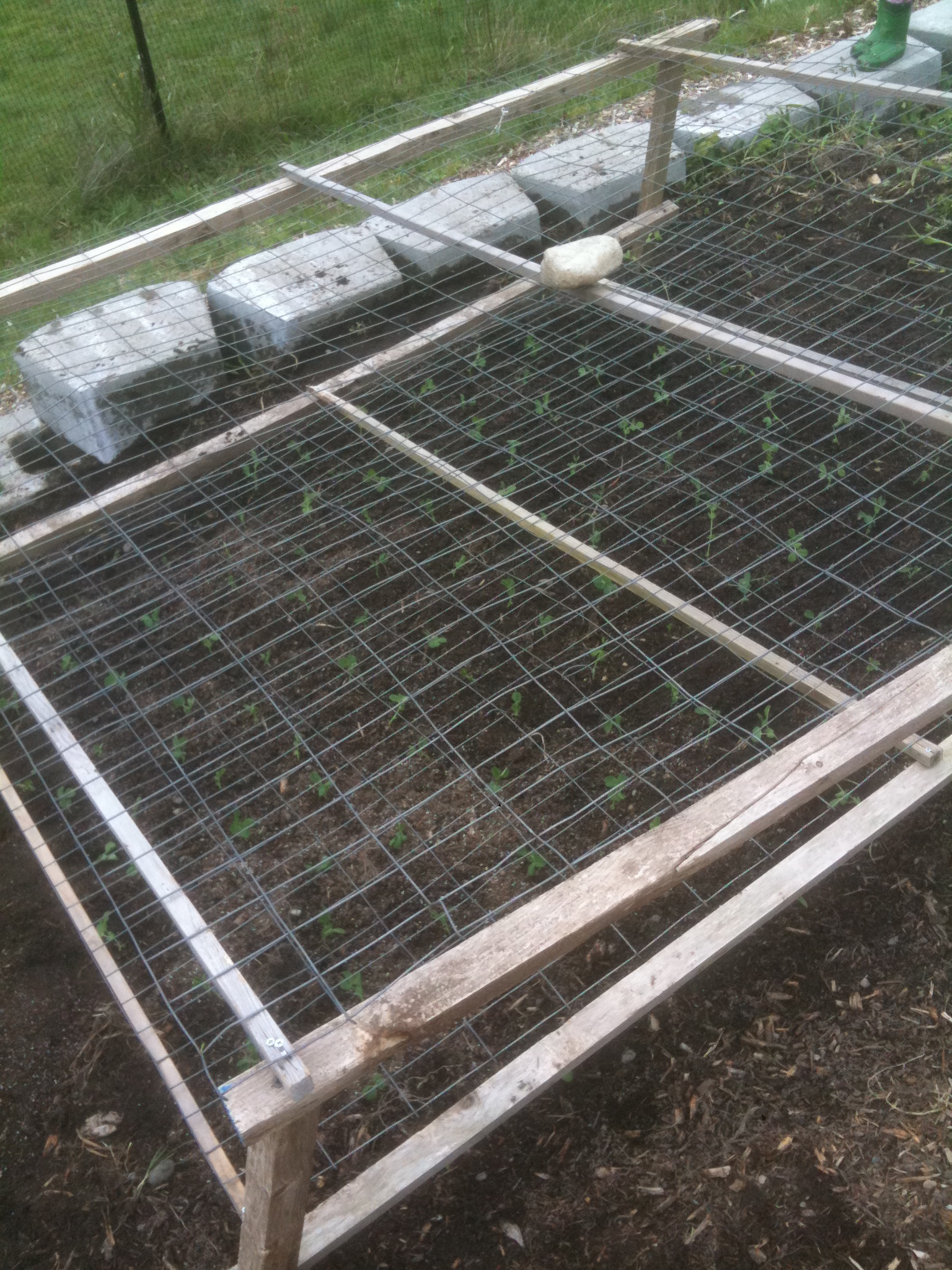 Hat tip to Modern Victory Garden for the idea behind our new shelling pea trellis.
Made of all salvage materials, we altered the design a bit to have it fit one of our more steep beds in the food forest. Since you harvest the shelling peas all at the same time, you do not need access to the interior of it for continual harvesting.
Given how many bags of frozen peas we go through in the winter, we may try to get two full growing cycles out of the trellis this season.
Maintaining grass without gas
Posted: April 11, 2011 Filed under: 3. Food Security, 4. Energy Security Comments Off on Maintaining grass without gas Joel Salatin, the godfather of this blog says he’s just a grass farmer. Ha! he’s actually a farmer of a significant number of animals and crops, but his meaning is clear. He takes care of the grass in the fields, and everything else falls into place.
To date I’ve been using a variety of tools for grass management which include a lightweight electric mower for the proper lawn around the house, a serious gas-powered DR mower for the pasture (hiking paths, electronet chicken fence), an electric weed-eater for trimming, and more. In general, I’m completely dependent upon oil or electricity. Not good.
Enter the scythe. After just a few sessions trimming the lawn proper and prepping the pasture for a new installation of chicken electronet fencing, I’m already loving this thing. At $200 for a complete setup, that’s well below the price of any of my existing tools, which are noisy, smelly, and more dangerous than this giant blade.
When you’re using a scythe, you don’t need eye/ear protection. In fact, I did a work telephone meeting last week while using it. Just a slight (and pleasant) woosh sound while you are working. And it is significantly more time efficient when compared to the overall time of the power tools including gassing up, charging batteries, and annual maintenance. Just grab the scythe + whetstone and off you go.
I’ll be selling off our other power tools for grass maintenance this month.
Benefits of cover crops
Posted: March 31, 2011 Filed under: 3. Food Security Comments Off on Benefits of cover crops I’ve been reading a lot of Wendell Berry recently again. Of all the places I lived as a child, I lived in Kentucky the longest, and have a natural affinity for Berry and his family farm there.
A reoccurring theme in his books and essays is one of simply needing more farmers. We need more farmers so we can pay more attention to the ground, and not just during harvest. He (wisely) laments the lack of cover crops in the typical agribusiness farm and notes it’s direct contribution to the loss of topsoil.
I took that to heart last year and began using cover crops as a way of not only retaining our topsoil, but adding nitrogen and other material to the beds more quickly and effectively with this green manure. This photo is last year’s potato patch – this year’s shelling pea patch – with the cover crop in process of being cut down and turned into the soil.
Manure Machines
Posted: March 26, 2011 Filed under: 3. Food Security Comments Off on Manure Machines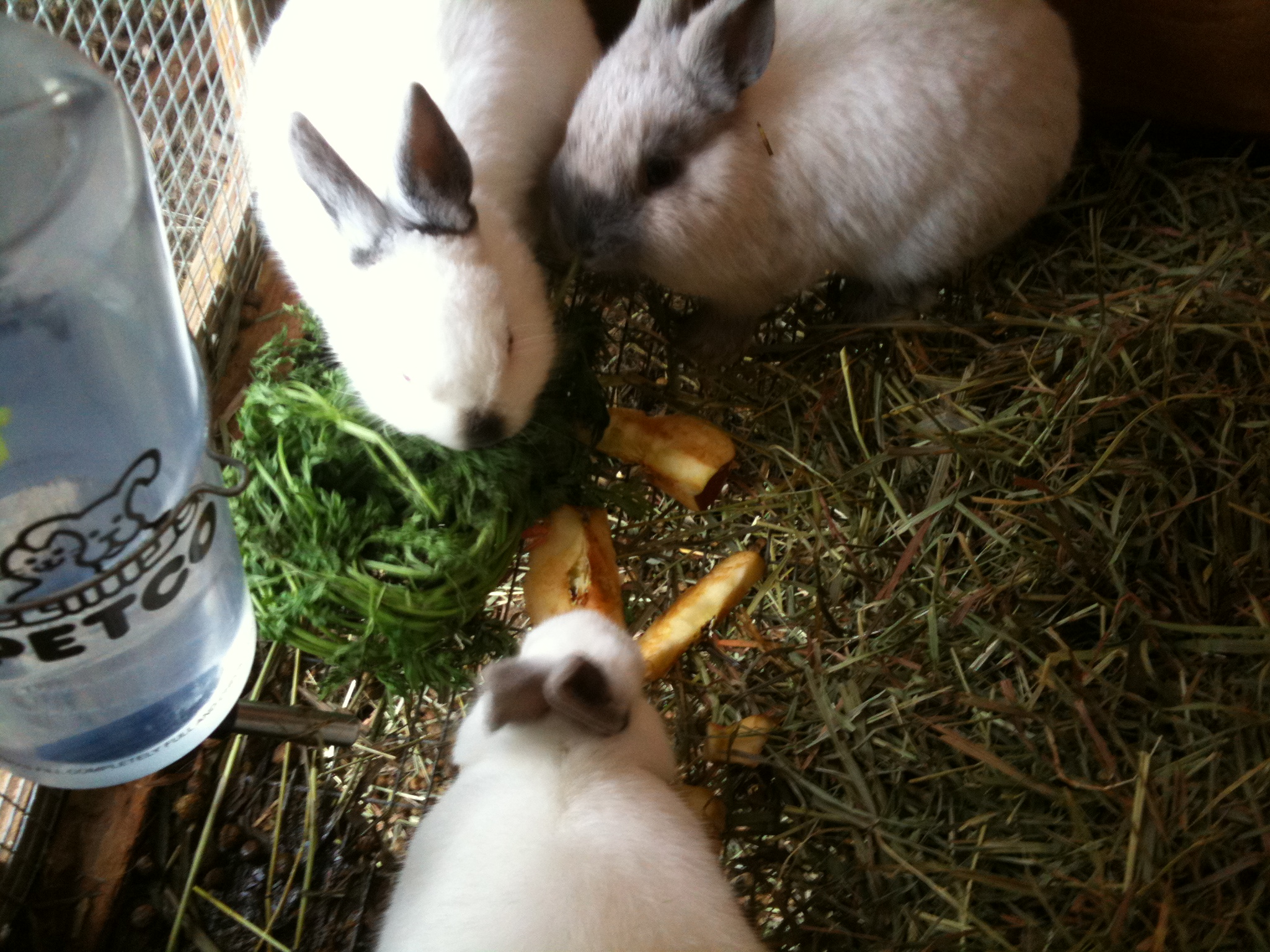 We added three bunnies into our food production chain this past winter.
No, we’re not eating them, but using them to process our kitchen food waste into manure pellets that can go directly onto our veggie beds and fruit trees. Rabbits are one of the few animals with manure that is not “hot”. Hot manure requires composting for a few months, else it will scorch your plants.
With a salvaged rabbit hutch from a friend, a cheap bale of Timothy hay, and free Craigslist bunnies, it is a low cost way to improve your garden soil. We sexed them to insure we would not walk out one morning to find 3 had turned into 30.
The kids love them, the German Shepherd herds them, and petting them for just a few minutes lowers your stress, too!
How to use coffee in your gardens
Posted: March 17, 2011 Filed under: 3. Food Security Comments Off on How to use coffee in your gardens I have a local friend who owns a coffee company. Two outputs from the roasting process is chaff and *lots* of burlap bags, which he was more than happy to part with. I’m going to try several experiments with them.
For the chaff, we used it this winter in our compost and sheet mulching for the new blueberry beds. For the burlap bags, we’re using them to line the pathways, and then covering them with free wood chips from local arborists.
After the fact, I found other folks doing similair experiments:
For a family that only drinks yerba mate, this is more coffee than we’ve had around for years!
Expanding our grow light setup
Posted: March 14, 2011 Filed under: 3. Food Security | Tags: grow lights Comments Off on Expanding our grow light setup At first I balked at the ~$100 price tag of these tents for grow lights, and I could not find any used ones. But then I calculated how much earlier we’d be able to grow our our produce and stop buying from the store and our CSA and the return-on-investment becomes an obvious good one.
We had our original setup of grow lights in our laundry room, but quickly ran out of space when the second wave of seeds needed to be sown. By moving the set up out to the unheated garage inside this tent, the existing two sets of lights + heat mats can be use to nurse along *many* more seedlings. The tent serves as an insulation barrier and the interior reflective surfaces allows the lights to reach many more seedlings.
An extra IKEA shelf system from the attic proved to be the right size to fit inside the tent with just four quick saw cuts. With the sun making its reappearance every few weeks, we’re looking forward to transplanting all these seedlings out into the food forest soon!
Protecting chickens from weasels
Posted: February 25, 2011 Filed under: 3. Food Security | Tags: battery, chicken, electronet, raccoon, solar, trap, weasel Comments Off on Protecting chickens from weasels We lost a bird this past winter to a weasel when the solar electronet was struggling with zero sun for a week. The primary lesson I learned was to rotate a backup battery weekly in the winter, with the second one recharging in the garage on a battery tender.
But I also learned the value of traps. What you see pictured here are a humane, no-kill raccoon trap and a smaller weasel trap.
Frankly, I did not know we even had weasels in our area until I compared all the signs from the kill to internet research. Weasels are very productive members of a forest ecosystem, so I don’t want to proactively hunt them. But placing these humane traps between the forest and our chickens serves as an inexpensive barrier to keep both of us happy.
The bait recommended to me by a local trapper is cheap cat food + marshmallows. Yes, marshmallows. Raccoons in particular can’t resist them. 🙂
Start your own chicken co-op
Posted: February 17, 2011 Filed under: 3. Food Security | Tags: chicken feed co-op, food co-operative Comments Off on Start your own chicken co-op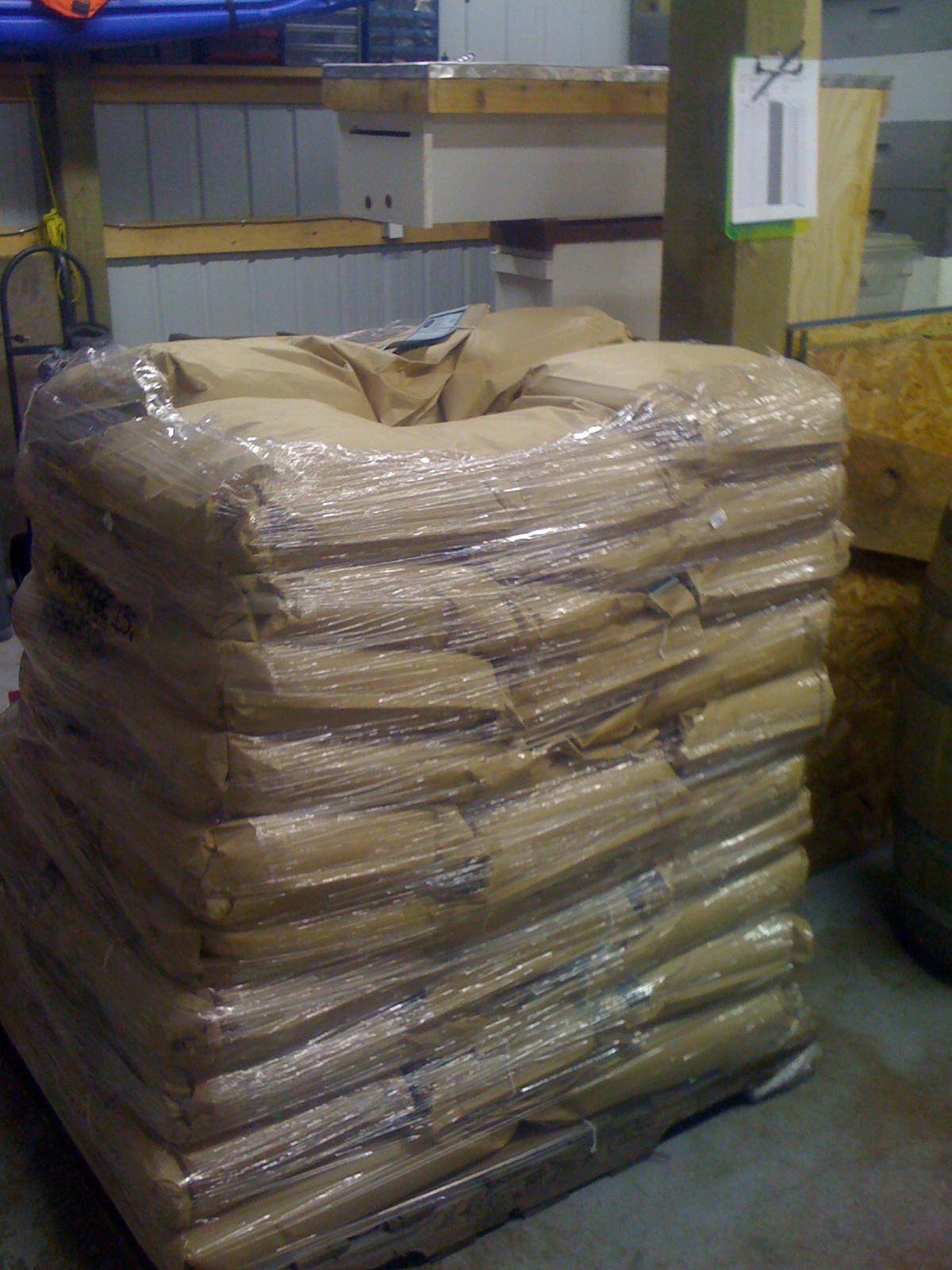 Last year we joined with several other local families doing experiments in building resilience to order chicks and chicken feed in bulk.
Despite ordering very high-end all organic feed, when ordered in bulk we’re paying less than what our local feed store sells non-organic mass market feed. While I am a rabid fan of Go Local, this is one instance where I think it is alright to bypass the local option in order to bring greater resilience to our small town.
We also achieve efficiencies when brooding chicks, sharing equipment and rotating every other season who has the brooding at their place.
All it takes is a few conversations with other backyard chicken folks to get started!
US military prepares for economic collapse
Posted: February 15, 2011 Filed under: 1. Philosophy, 3. Food Security, 6. Personal Training, 7. Physical Security Comments Off on US military prepares for economic collapseI’m glad I live in a country where our military folks have the resources to learn via roleplaying and what-if scenarios. It’s a useful way to learn and explore all the aspects of a given topic. But it also makes me nervous-as-all-get-out when I read this:
The Army has launched an operation called “Unified Quest 2011” in which it studies the “implications of ‘large scale economic breakdown’ inside the United States that would force the Army to keep ‘domestic order amid civil unrest.'” The 2011 Unified Quest lends truth to assertions that the United States is indeed not witnessing an upward economic recovery, as so many in our federal government have asserted. Soldiers are being trained in evacuation and detainment as a response to rioting, revealing the possibility that the United States military may resort to martial law in order to maintain order. Unified Quest 2011 also prepares soldiers to act as diplomats in the event that there is a limited availability of diplomats at combat outposts, or on the streets contending with hungry and angry Americans.Ugh. You can read this either positively or negatively. I’m frankly not sure which is closer to the truth of reality.
How to (not) store potatoes
Posted: February 8, 2011 Filed under: 3. Food Security Comments Off on How to (not) store potatoes Well, I’ve now learned how *not* to store potatoes.
I stored a portion of our good potato harvest in hay, the other in shredded paper. The hay was definitely easier, faster, and less messy. And, in turns out, the right medium to use.
I showed a buddy what you see in the nearby photo and he immediately said, “Well duh, paper is a desiccant.”
A what?
It turns out his father was a paper maker, who used desiccants in the process. A desiccant sucks the water out of whatever is near it. Those little things in your vitamin bottle are desiccants. I inadvertently sucked all the moisture right out of my potatoes.
Oops. Good thing I’m learning this lesson now, while we still have access to relatively inexpensive food from our local co-op. Next time I’ll stick with hay.
 Opt Out En Masse